

TECHNICAL DOCUMENTATION
SSP 861803 Tiguan Haldex All-Wheel Drive
Loading PDF…
Read document text
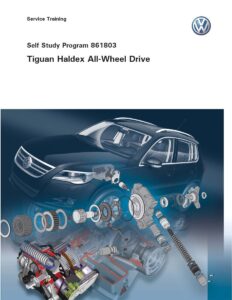
Service TrainingSelf Study Program 861803Tiguan Haldex All-Wheel Drive
Volkswagen of America, Inc. Volkswagen Academy Printed in U.S.A. Printed 1/2008 Course Number 861803©2008 Volkswagen of America, Inc. All rights reserved. All information contained in this manual is based on the latest information available at the time of printing and is subject to the copyright and other intellectual property rights of Volkswagen of America, Inc., its affiliated companies and its licensors. All rights are reserved to make changes at any time without notice. No part of this document may be reproduced, stored in a retrieval system, or transmitted in any form or by any means, electronic, mechanical, photocopying, recording or otherwise, nor may these materials be modified or reposted to other sites without the prior expressed written permission of the publisher. All requests for permission to copy and redistribute information should be referred to Volkswagen of America, Inc. Always check Technical Bulletins and the latest electronic repair information for information that may supersede any information included in this booklet. Trademarks: All brand names and product names used in this manual are trade names, service marks, trademarks, or registered trademarks; and are the property of their respective owners.
ContentsIntroduction . . . . . . . . . . . . . . . . . . . . . . . . . . . . . . . . . . . . . . . . 1Overview . . . . . . . . . . . . . . . . . . . . . . . . . . . . . . . . . . . . . . . . . . 2Drivetrain . . . . . . . . . . . . . . . . . . . . . . . . . . . . . . . . . . . . . . . . . . 4All-Wheel Drive Clutch Details . . . . . . . . . . . . . . . . . . . . . . . . . . . 9Controls . . . . . . . . . . . . . . . . . . . . . . . . . . . . . . . . . . . . . . . . . . 17Service . . . . . . . . . . . . . . . . . . . . . . . . . . . . . . . . . . . . . . . . . . 23Knowledge Assessment . . . . . . . . . . . . . . . . . . . . . . . . . . . . . . . 25NoteImportant!This Self-Study Program provides information regarding the design and function of new models. This Self-Study Program is not a Repair Manual.This information will not be updated. For maintenance and repair procedures, always refer to the latest electronic service information.iii
Page intentionally left blank
IntroductionIntroductionslip at other wheels. The distribution of the drive forces to the axles is variable and depends on the driving conditions. The new all-wheel drive clutch in 4MOTION responds rapidly to any driving situation and maintains the best possible traction at all times.Volkswagen has used a Haldex clutch for the 4MOTION all-wheel drive since 1998. A new generation of the all-wheel drive clutch is now used by Volkswagen for the first time in the Tiguan. The new all-wheel drive clutch is controlled electronically. It allows torque to be transmitted to the drive wheels that have traction regardless ofS414_0021
OverviewOverviewHistoryIn 1998, 4MOTION drive replaced synchro all-wheel drive at Volkswagen. While the synchro all-wheel drive used a visco clutch, an all-wheel clutch by Haldex was used for the first time in the 4MOTION drive. With this hydraulic multiplate clutch, the all-wheel drive could be controlled electronically. Apart from slip control, the control module also allowed handling dynamic driving conditions such as curves, speed, and overrun, or load operation.First Generation Haldex ClutchFunction of Haldex ClutchesThe first two generations of the Haldex clutch use a rotational speed difference between the front and rear axles to operate. A pump effect is generated using a cam plate, rollers, and two reciprocating pistons working in parallel. This creates oil pressure that compresses the multiplate clutch through a working piston. The drive torque transferred determines the amount of pressure applied. The pressure on the multiplate disks of the clutch is regulated through: • Suction valves • Pressure valves • Electronic control valve • Control moduleS414_003Generation II Haldex Clutch from Model Year 2004S414_0042
OverviewHaldex Generation IV All-Wheel Drive ClutchThe power transfer through the multiplate pack of the generation IV all-wheel drive clutch is nearly identical to the previous Haldex models. Generating the pressure with an electric pump is a new feature. The torque to be transferred is determined by All Wheel Drive Control Module J492 through the selection of Haldex Clutch Control Valve N373. Speed differences between the front and rear axles are no longer a prerequisite for activating the all-wheel drive clutch.Advantages• Clutch selection independent from the driving situation • Rapid torque build-up • Permanent rear wheel drive capacity • Unrestricted compatibility with the slip control systems (e.g. ESP, ABS)Technical Features• Electro-hydraulically controlled multiplate clutch • Integrated in the rear axle drive • Simplified hydraulic circuit • Optimized demand-controlled pump selectionS414_0053
DrivetrainDrivetrain4MOTION Drivetrain SystemThe front wheels are conventionally driven by the front axle differential. At the same time, the torque is transferred to the propeller shaft by this differential through the angle transmission. Depending on the degree of engagement of the allwheel drive clutch, a torque that matches the driving situation is transmitted to the rear axle drive.EngineAngle TransmissionPropeller Shaft Rear Axle DriveAll-Wheel Drive Clutch Transmission Rear Axle DifferentialFront Axle DifferentialS414_0074
DrivetrainAngle TransmissionThe angle transmission increases the torque to the propeller shaft by a factor of 1.6. The diameter of the shaft can be smaller for this reason, since it transfers a smaller torque. In the rear axle drive, the torque is reduced again by the same factor of 1.6.Output to Right WheelDrive from Transmission and Output to Left WheelOutput to Propeller ShaftPower FlowThe force is transferred from the spur gear to the propeller shaft by the differential cage of the differential, the hollow shaft with crown wheel, and the pinion.From TransmissionS414_008Differential CageHollow ShaftOutput to Left WheelOutput to Right WheelSpur GearPinion Output to Propeller ShaftCrown WheelS414_0095
DrivetrainPropeller ShaftThe propeller shaft has two parts. They are linked by a center joint. Flexible disk joints are used to make the connection to the transfer case and the all-wheel drive clutch. A rotational vibration absorber is permanently attached to the rear flexible disk joint and cannot be serviced separately. It reduces the transfer of engine vibrations through the rear axle differential to the body.Center Joint Flexible Disk Joint with Rotational Vibration AbsorberFlexible Disk JointDirection of TravelRear Flexible Disk JointThe rear axle transmission and the propeller shaft are balanced during production. For this reason the drivetrain does not require balancing in the vehicle.Rotational Vibration AbsorberCenter JointS414_010The center joint is press-fitted and cannot be separated. This results in a compact and light design and the roll bellows is better protected.No Balancing RequiredRoll BellowsS414_011S414_0126
DrivetrainRear Axle DriveThe all-wheel drive clutch is integrated in the rear axle drive.Crown Wheel Rear Axle Drive Pinion All-Wheel Drive Clutch Multiplate PackRear Axle DifferentialAll-Wheel Drive Clutch Oil Reservoir Drive Shaft All Wheel Drive Control Module J492S414_0137
DrivetrainFunction of the All-Wheel Drive ClutchThe all-wheel drive clutch between front and rear axle drives controls the drive torque to the rear axle. Depending on the degree of engagement, the allwheel drive clutch directs the required drive torque to the rear axle.All-Wheel Drive Clutch Components Multiplate Pack AccumulatorOil FilterHaldex Clutch Pump V181Haldex Clutch Control Valve N373All Wheel Drive Control Module J492 Oil Circuit Components Multiplate ClutchS 414_014Haldex Clutch Control Valve N373All Wheel Drive Control Module J492Accumulator Haldex Clutch Pump V181S414_0648
All-Wheel Drive Clutch DetailsAll-Wheel Drive Clutch DetailsOverviewThe individual all-wheel drive clutch component groups are shown here to provide a better understanding of how they work.Mechanical AssemblySpring PlateNeedle BearingThrust PlatesWorking Pistons Needle Bearing Drive HubMultiplate PackClutch Cage Electro-Hydraulic Assembly and All Wheel Drive Control Module J492 All Wheel Drive Control Module J492 Haldex Clutch Control Valve N373S414_015Accumulator Haldex Clutch Pump V181Oil FilterS414_0409
All-Wheel Drive Clutch DetailsMechanical AssemblyThe following sub-groups belong to the mechanical assembly: • Multiplate clutch • Working piston • Spring plate The entire assembly creates the frictional connection between front and rear axles. The multiplate pack is compressed when pressure is applied to the working piston. Depending on the contact pressure, a different torque (up to 1770 lbs-ft or 2400 Nm) can be transferred. The friction plates have internal teeth that engage the drive hub. The steel plates engage the clutch cage with external teeth. The number of plates depends on the vehicle type. Multiplate Pack The multiplate pack consists of friction plates and steel plates, with one thrust plate in the front and one in the rear.Multiplate ClutchThe multiplate clutch consists of the drive hub, the multiplate pack and the clutch cage. Drive Hub The drive hub is driven by the propeller shaft via the flange.Steel Plate Friction PlateThrust PlateS414_042Thrust PlateS414_041From Propeller ShaftMultiplate PackS414_052Drive HubS414_05110
All-Wheel Drive Clutch DetailsClutch Cage The clutch cage is connected with the pinion of the rear axle by a spline, and transfers the drive torque to the rear axle.Rear Axle PinionClutch CageS414_053SplinesS414_043Working PistonThe working piston is a cylindrical piston. Function When actuating the clutch, the pressure of the working piston is transferred to the multiplate pack via a needle bearing. The working piston does not turn. The multiplate pack, on the other hand, rotates at drive speed.Needle BearingS414_054Working PistonS414_044Spring PlateThe spring plate is located on the oil pressure side of the working piston. Function It creates a preload which pushes the working piston in place. This removes the play from the multiplate pack and the needle bearings.Spring PlateOil Pressure SideS414_045S414_05511
All-Wheel Drive Clutch DetailsElectro-Hydraulic AssemblyThe electro-hydraulic assembly consists of the Haldex Clutch Pump V181, the oil filter, the accumulator, and the Haldex Clutch Control Valve N373.Haldex Clutch Pump V181The Haldex Clutch Pump V181 is a reciprocating piston pump and is installed in the lower section of the all-wheel drive clutch. It generates the oil pressure. The accumulator in the oil circuit is filled regularly. It is requested by the All Wheel Drive Control Module J492 depending on the demand. Function The bores of the cylinder housing each contain a piston with a locating pin and a return spring. With the help of an angular ball bearing, the piston and locating pin are moved in stroke fashion when the cylinder housing turns so that oil is drawn in at the bottom and is discharged compressed at the top after 180 degrees of rotation. Effects of Failure When the Haldex Clutch Pump V181 fails, oil pressure cannot be generated. Torque is no longer transferred to the rear axle.S414_046Compressed Oil Is DischargedOil Is Drawn InCylinder Housing Ball BearingTo AccumulatorPiston Locating Pin From Oil Reservoir Return SpringS414_022Oil FilterThe oil filter is a no-maintenance fleece filter. A check valve is integrated in the oil filter housing which prevents the oil pressure to the Haldex Clutch Pump V181 from dropping.12
All-Wheel Drive Clutch DetailsAccumulatorThe compact design of the accumulator includes three parallel acting springs and is positioned on top of the clutch. It adjusts the oil pressure using spring force and keeps it at 435 psi (30 bar). System without Pressure: The springs of the accumulator are relieved.From Pump to ValveReturn to Oil ReservoirS414_016System with Working Pressure: The pressure chamber is filled by the pump. The pressure piston is pushed back and the spring is under tension.Return Channel Pressure PistonPressure ChamberReturn to Oil ReservoirReturn ChannelS414_017If the oil pressure exceeds 435 psi (30 bar), the return channels become accessible, the pressure in the direction of the oil reservoir is reduced, and oil returns to the reservoir.Pressure ChamberReturn Channel Return to Oil ReservoirS414_01813
All-Wheel Drive Clutch DetailsHaldex Clutch Control Valve N373Task The Haldex Clutch Control Valve N373 controls the working pressure that is passed on to the working pistons. Pressure increases in proportion to the electric current applied to the solenoid. Pressure is precisely defined for each current value.SpringNeedle To Oil Reservoir Bore To Working PistonRegulating Chamber From AccumulatorControl Piston Solenoid CoilMagnet Core Electrical ConnectorS414_01914
All-Wheel Drive Clutch DetailsFunction The Haldex Clutch Pump V181 and the accumulator have built a pressure of 435 psi (30 bar). (1) Applying an electrical current to the solenoid coil generates a magnetic force the amount of which depends on the current applied. This moves the control piston up, opens the flow, and the working pressure is generated. (2) When the desired working pressure has been reached, the balance of force described below is established so that the flow is closed and the working pressure maintained. (3) The working pressure is applied to the working piston and in the control piston regulating chamber. The pressure in the regulating chamber works in the same direction as the return force of the spring and supports it as counteracting force to the magnetic force. A balance of force is achieved. When the full current is applied, the intake on the bottom remains open and the entire oil pressure generated by Haldex Clutch Pump V181 is used as working pressure.Magnetic Force1 Oil Pressure 435 psi (30 bar)2 Working Pressure Generated3 Flow Closed, Working Pressure MaintainedS414_020Spring ForceCompression ForceRegulating ChamberIf the clutch has to be opened, no more current will be applied to the solenoid coil, the control piston returns to its original position, and the pressure is relieved by routing oil to the oil reservoir. Effects of Failure If the Haldex Clutch Control Valve N373 fails, the allwheel function is no longer available.S414_021Working Pressure Routed to Oil ReservoirS414_02315
All-Wheel Drive Clutch DetailsAll Wheel Drive Control Module J492Task All Wheel Drive Control Module J492 regulates the pump operating times and Haldex Clutch Control Valve N373. The amount of pressure is solely determined by the valve position. A temperature sensor is located on the printed circuit board of All Wheel Drive Control Module J492 where its measured values indicate the oil temperature. All Wheel Drive Control Module J492 is integrated in the CAN data bus drive. This allows precise control of the system with only one sensor. Based on data on the driving situation, the All Wheel Drive Control Module J492 determines the desired pressure so that the amount of all-wheel drive clutch engagement and transfer are adjusted to the situation. In case of ESP or ABS intervention, ABS Control Module J104 determines the amount of all-wheel drive clutch engagement via All Wheel Drive Control Module J492. Effects of Failure Because Haldex Clutch Control Valve N373 can no longer be selected, no more working pressure is generated. The clutch is disengaged and the rear axle is no longer driven.All Wheel Drive Control Module J492S414_02416
ControlsControlsOil CircuitThe electro-hydraulic components build up the oil pressure, controlling the contact pressure on the multiplate clutch.Working Piston Haldex Clutch Control Valve N373Spring PlateReturn AccumulatorMultiplate ClutchOil FilterAll Wheel Drive Control Module J492Oil ReservoirStrainerHaldex Clutch Pump V181S414_027System Without PressureThe illustration shows the system in the depressurized state. As long as the engine is off and only the ignition is turned on, All Wheel Drive Control Module J492 is selected but no pressure is generated. The Haldex Clutch Control Valve N373 is opened without current. Because a small amount of pressure is applied through the spring plate, a speed of 31 mph (50 km/h) and a distance of 31 miles (50 km) may not be exceeded when towing with one axle raised.A Pressureless System Is Needed in These Situations Towing Roll DynamometerS414_030S414_03117
ControlsPressure Buildup at Engine StartWhen the engine is started, Haldex Clutch Pump V181 is activated. Haldex Clutch Pump V181 is selected as soon as an engine speed of 400 rpm is reached. It delivers oil via the filter to the accumulator until a pressure of 435 psi (30 bar) is reached in the oil circuit. Haldex Clutch Control Valve N373 is closed by All Wheel Drive Control Module J492 so that the working pressure is passed on to the working piston and the multiplate pack is compressed. Starting When starting to drive and when accelerating, the entire rear axle drive torque is immediately available. Driving In each driving situation, the pressure between pump and valve is kept constant at 435 psi (30 bar)Haldex Clutch Control Valve N373through the accumulator. The working pressure is solely controlled through Haldex Clutch Control Valve N373, which can adjust the contact pressure on the working piston according to the demand. This working pressure may lie between 0%, such as when braking, and 100%, as when accelerating.Controlled Working PressureOil Pressure 0 – 435 psi (0 – 30 bar)S414_029Working PistonOil Pressure 0 – 435 psi (0 – 30 bar) Spring Plate Oil Pressure 435 psi (30 bar) Return AccumulatorMultiplate ClutchOil FilterAll Wheel Drive Control Module J492Oil ReservoirStrainerHaldex Clutch Pump V181S414_02818
ControlsDriving ScenariosDrive Torque at the Rear AxleStarting or Accelerating A high drive torque is required at the rear axle. The valve closes completely and the contact pressure can reach its maximum.100%Control Range0% Starting/AcceleratingS414_056 SS414_032Fast Driving Only a low torque is required at the rear axle. The contact pressure is controlled according to demand (control range).100%Control Range 0% Fast DrivingS414_057 S414_033Braking No torque is transferred to the rear axle when braking. The valve is opened and the pressure on the working piston is reduced. The clutch is disengaged.100%0% BrakingS414_058 S414_049Stopping The clutch is disengaged as long as the vehicle is being braked. When the vehicle is stopped, the precontrol uses the signal from the accelerator position. When starting to drive, the pressure is built up again and full torque capacity is available.100%0% StoppingS414_059 S414_034Parking Maneuvers Only a low torque is transferred during parking maneuvers. The drivetrain is not under tension. The clutch is controlled according to demand (control range).100%Control Range 0% Parking ManeuversS414_057 S414_03519
ControlsCritical Driving SituationsDriving on Slippery Roads The working pressure is controlled according to demand. Signals come from ABS Control Module J104, which detects slippage through the speed sensors and calculates the required traction. ESP or ABS Intervention When a wheel slip control system is activated, the amount of clutch engagement is controlled indirectly through the ABS Control Module J104. For example, the clutch may be disengaged entirely for an ABS intervention while it can be engaged for an ESP intervention.Drive Torque at the Rear Axle 100% Control Range0%Driving on Slippery Roads ESP or ABS InterventionS414_060S414_036Starting with Slip (On Ice or Snow) The all-wheel clutch is engaged when both wheels of the front axle spin. The rear axle takes on all of the drive force.S414_065S414_038If only one wheel of the front axle spins, the Electronic Differential Lock (EDL) becomes active. The spinning wheel is braked and the drive force of the other wheel is increased. At the same time the all-wheel drive clutch is engaged and a large portion of the drive force is transferred to the rear axle.S414_06220
ControlsSystem OverviewSensorsEngine Speed (RPM) Sensor G28 Engine Control Module (ECM) J623ActuatorsThrottle Position (TP) Sensor G79Drive CAN Data Bus ABS Wheel Speed SensorS G44-G47 All Wheel Drive Control Module J492Haldex Clutch Control Valve N373ABS Control Module J104Brake Light Switch FHaldex Clutch Pump V181Electro-Mechanical Parking Brake Control Module J540Data Bus On Board Diagnostic Interface J533Steering Angle Sensor G85A sensor cluster is integrated in Electro-Mechanical Parking Brake Control Module J540. It contains the sensors for lateral acceleration, longitudinal acceleration, and yaw rate.S414_02621
ControlsFunctional Diagram30 J540J104J623 S G85N373 J492 V18131G85 J104 J492 J540 J623 N373 S V181Steering Angle Sensor ABS Control Module All Wheel Drive Control Module Electro-Mechanical Parking Brake Control Module Engine Control Module Haldex Clutch Control Valve Fuse Haldex Clutch PumpColor CodingPositive Ground CAN Data Bus LineS414_04722
ServiceServiceTesting Individual ComponentsIndividual component tests can be called through function and component selections in Guided Fault Finding.Guided Fault Finding Function/Component selection Select function or component + Chassis + All-wheel drive with Haldex clutch (4th generation) + 01 - Systems capable of self-diagnostics + Electrical components G79 - Throttle Position Sensor J492 - All Wheel Drive Control Module N373 - Haldex Clutch Control Valve V181 - Haldex Clutch Pump VOLKSWAGENModeEnterPrint S414_069All Wheel Drive Control Module J492 SelfDiagnostics All Wheel Drive Control Module J492 has the address word 22 for self-diagnostics.The all-wheel drive clutch can be replaced separately. Elaborate adjustment activities after replacement are no longer necessary because the pinion is part of the rear axle transmission and is not replaced.High-performance oil was developed especially for the requirements of the generation VI all-wheel drive clutch.23
Notes24
Knowledge AssessmentAn on-line Knowledge Assessment (exam) is available for this Self-Study Program. The Knowledge Assessment may or may not be required for Certification. You can find this Knowledge Assessment at:www.vwwebsource.comFor Assistance, please call:Volkswagen Academy Certification Program Headquarters 1 – 877 – 791 – 4838 (8:00 a.m. to 8:00 p.m. EST)Or, E-Mail:concierge@volkswagenacademy.com25
Volkswagen of America, Inc. 3800 Hamlin Road Auburn Hill, MI 48326 Printed in the U.S.A. January 2008