

TECHNICAL DOCUMENTATION
SSP 085 KESSY system in Škoda vehicles
Loading PDF…
Read document text
ServiceKESSY systemin Škoda vehicles85Protected by copyright. Copying for private or commercial purposes, in part or in whole, is not permitted unless authorised by ŠKODA AUTO A. S. ŠKODA AUTO A. S. does not guarantee or accept any liability with respect to the correctness of information in this document. Copyright by ŠKODA AUTO A. S.�Self-study programme
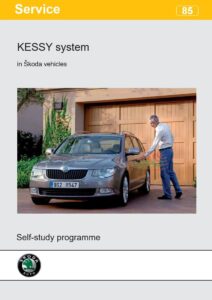
It allows you to open the doors, start or switch off the engine and to exit the vehicle after closing and locking the doors without taking the vehicle key out of your trouser pocket. The KESSY system (Keyless Entry Start and Exit SYstem) combines the benefits of this exclusive comfort feature in the model range Superb. We would like to introduce you to this modern system presented in this study material.SP85_21Protected by copyright. Copying for private or commercial purposes, in part or in whole, is not permitted unless authorised by ŠKODA AUTO A. S. ŠKODA AUTO A. S. does not guarantee or accept any liability with respect to the correctness of information in this document. Copyright by ŠKODA AUTO A. S.�2GB
ContentsKESSY system 4Components of the KESSY system Wiring diagram of the KESSY system6 7 8Opening and locking the vehicleElectrical Steering Column Lock ESCL12 14Keyless start-up of the vehicleYou will find notes for the assembly and disassembly, repair and diagnostics as well as detailed user information in the workshop manuals, in the diagnostic unit VAS 505xby and in Copying the for private or commercial purposes, in part or in whole, is not permitted Protected copyright. unless authorised by ŠKODA AUTO A. S. ŠKODA AUTO A. S. does not guarantee or accept any liability on-board literature. with respect to the correctness of information in this document. Copyright by ŠKODA AUTO A. S.� The time for going to press was on the 04/2010. This brochure is not subject to update.GB3
KESSY systemKESSY systemThe models Superb and Superb Combi are fitted with the KESSY system (Keyless Entry Start and Exit System) which allows convenient opening/locking as well as start-up of the vehicle without actively using a remote control key (it is sufficent that the key is inside the vehicle, for example in the trouser pocket of the driver, in order to start the vehicle). The central locking function can still be activated by means of the remote control button on the key, furthermore a component is integrated in the key to enable the communication with the KESSY system. The Electrical Steering Column Lock ESCL is a component of the KESSY system and replaces the mechanical steering wheel lock. Another element is the start button which replaces the ignition lock.SP85_01Protected by copyright. Copying for private or commercial purposes, in part or in whole, is not permitted unless authorised by ŠKODA AUTO A. S. ŠKODA AUTO A. S. does not guarantee or accept any liability with respect to the correctness of information in this document. Copyright by ŠKODA AUTO A. S.�4GB
Installation of the components for the KESSY system in the vehicleag bccddf eSP85_07a - start button b - control unit of the KESSY system c - capacitive sensors in the handles of the front doors/external antenna of the KESSY systemd - internal antenna of the KESSY system e - micro switch of the luggage compartment flap f - external antenna of the KESSY system g - internal antenna of the KESSY systemGBProtected by copyright. Copying for private or commercial purposes, in part or in whole, is not permitted unless authorised by ŠKODA AUTO A. S. ŠKODA AUTO A. S. does not guarantee or accept any liability with respect to the correctness of information in this document. Copyright by ŠKODA AUTO A. S.�5
Components of the KESSY systemComponents of the KESSY systemStart button - serves to switch on/off the ignition (15) and to start/stop the engineSP85_10Control unit of the KESSY system - controls the wireless communication of the system with the key - evaluates the position of the key using the antennas - responds upon contact with the capacitive sensorsSP85_14Capacitive sensors - detect the contact with the exterior handles of the front doors based on the change in capacitanceSP85_13Antennas of the KESSY system - The ferrite antennas serve to detect the exact position of the key when starting the vehicle and operate the central locking systemSP85_15Micro switch of the luggage compartment flap - is used for keyless opening of the luggage compartment flapProtected by copyright. Copying for private or commercial purposes, in part or in whole, is not permitted unless authorised by ŠKODA AUTO A. S. ŠKODA AUTO A. S. does not guarantee or accept any liability with respect to the correctness of information in this document. Copyright by ŠKODA AUTO A. S.�SP85_206GB
Wiring diagram of the KESSY systemWiring diagram of the KESSY systemaied hbfgSP85_19ca b c d e fdash panel insert onboard supply control unit BCM CAN bus Protected by copyright. Copying for private or commercial purposes, in part or in whole, is not permitted control unit of the KESSY system unless authorised by ŠKODA AUTO A. S. ŠKODA AUTO A. S. does not guarantee or accept any liability Transmitter with respect to the correctness of information in this document. Copyright by ŠKODA AUTO A. S.� electrical Steering Column Lock ESCL wireless data transmission (125 kHz) start button wireless data transmission (433 kHz) capacitive sensors in the handles of the front wireless data transmission doors g - antenna h - key i - reading coil-GB7
Opening and locking the vehicleKeyless unlocking and locking of the vehicleCapacitive sensors, integrated in the exterior door handles of the front doors, are used for keyless unlocking or locking of the vehicle. The KESSY system is notified whether the driver wishes to open or close the vehicle doors by touching the exterior door handles of the vehicle. Then the control unit of the KESSY system searches for the authorised key. This key must be located on the side of the vehicle where the door handle was touched, however not exceeding a distance of 1.5 m.SP85_22Unlocking the vehicle For keyless unlocking of the vehicle, it is suf ficient to pull on the door handle or to touch the capacitive sensor on the inside of the door handle, resulting in a two-way communication between the vehicle and the key. This communication is performed in two steps. During the first step, the KESSY keys located in the proximity of the relevant door handle are assigned to the KESSY control unit. During the second step, the keys belonging to the vehicle receive a command from the control unit of the KESSY system and are authorised. After successful authorisation, the door locks are unlocked by the onboard supply control unit BCM.Surface of the capacitive sensor for unlocking the vehicleSP85_03Protected by copyright. Copying for private or commercial purposes, in part or in whole, is not permitted unless authorised by ŠKODA AUTO A. S. ŠKODA AUTO A. S. does not guarantee or accept any liability with respect to the correctness of information in this document. Copyright by ŠKODA AUTO A. S.�8GB
Locking the vehicleFor keyless locking of the vehicle after closing the doors, it is necessary to touch the capacitive sensor on the surface of the exterior door handle of the front door. This ensures that communication is established between the vehicle and the key, which is performed in two steps just as for unlocking the vehicle. During the first step, the KESSY keys located in the proximity of the relevant door handle are assigned to the KESSY control unit. During the second step, the keys belonging to the vehicle receive a command from the control unit of the KESSY system and are authorised. After the successful authorisation, the locking of the doors is ensured by the onboard supply control unit BCM. When the first command is given to lock the vehicle via the capacitive sensor, the system changes to the locked state "SAFE" in accordance with the standard. When the second command is given to lock the vehicle, the system changes to the state "externally locked" (the lock is deactivated) within 5 s.SP85_02Surface of the capacitive sensor for locking the vehicleCheck the locking of the vehicle After locking the vehicle via the capacitive sensor, it is not possible to unlock the vehicle again by touching this sensor on the same door handle for a period of 2 s. This enables to check whether the vehicle is in fact locked without the need to unlock the door locks again.Protected by copyright. Copying for private or commercial purposes, in part or in whole, is not permitted unless authorised by ŠKODA AUTO A. S. ŠKODA AUTO A. S. does not guarantee or accept any liability with respect to the correctness of information in this document. Copyright by ŠKODA AUTO A. S.�GB9
Opening and locking the vehicleCourse of communication of the KESSY system when unlocking/locking the vehiclecapacitive sensor KESSY control unit Door lock BCM Keycommand for unlocking 1 LF scan* 2 UHF response 3 timely sequence ID of the key 4 internal communication 5 LF scan* 6 UHF identification 7 authentication 8 unlocking signal 9SP85_04*LF scan - signal sent by the KESSY control unit for checking the authorisation of the keyProtected by copyright. Copying for private or commercial purposes, in part or in whole, is not permitted unless authorised by ŠKODA AUTO A. S. ŠKODA AUTO A. S. does not guarantee or accept any liability with respect to the correctness of information in this document. Copyright by ŠKODA AUTO A. S.�Switching off the capacitive sensors in the door handles of the vehicle If nobody enters the vehicle for a certain period of time, the capacitive sensors in the door handles of the vehicle are deactivated. The capacitive sensors in the door handle on the front passenger side are deactivated after 60 hours. They are reactivated after fulfilling one of the following conditions: - keyless opening via the driver's door or the luggage compartment flaps - pressing the remote control button of the central locking system within the range of the vehicle - mechanical unlocking of the vehicle (using the lock below the trim panel in the door handles of the front doors) The capacitive sensors in the door handle on the driver's side are deactivated after 90 hours. They are reactivated after fulfilling one of the following conditions: - pressing the remote control button of the central locking system within the range of the vehicle - mechanical unlocking of the vehicle (using the lock below the trim panel in the door handles of the front doors)10GB
Keyless unlocking of the luggage compartment flapThe keyless unlocking of the luggage compartment flap can be carried out by pressing the "SoftTouch" micro switch for opening the luggage compartment flap. This ensures that communication is established between the vehicle and the key, which is performed in two steps just as for unlocking and locking the vehicle. During the first step, the KESSY keys located in the proximity of the relevant door handle are assigned to the KESSY control unit. During the second step, the keys belonging to the vehicle receive a command from the control unit of the KESSY system and are authorised. After successful authorisation, the lock of the luggage compartment flap is unlocked by the onboard supply control unit BCM. In the case of the Superb Combi model, which is fitted with the system for the electrical operation of the luggage compartment flap, this flap is opened after pressing the micro switch. On the Superb Limousine model, which is fitted with the TWINDOOR system, the adjustment of the lock actuators is carried out after pressing the right micro switch for opening the large flap. Then the middle micro switch must be pressed for unlocking the flap lock.Protection against locking the key inside the vehicleA function is implemented in the KESSY system which prevents locking the key accidentally inside the vehicle. After locking the vehicle and subsequently closing the last door contact including the luggage compartment flap, the KESSY system detects if a key which was previously used for locking the vehicle is left inside the vehicle. If this is the case, the vehicle is unlocked again by the KESSY system. The occupants are informed about the activation of the protection against locking the key inside the vehicle by means of visual signalling of the warning lights, a message on the information display of the dash panel insert and also by an acoustic signal in the event that the vehicle is fitted with an alarm system.Convenience closing of the windowsProtected by copyright. Copying for private or the commercial purposes, in part or in whole, is not permitted If the vehicle is locked via the capacitive sensor for closing vehicle and the capacitive sensor unless authorised by ŠKODA AUTO A. S. ŠKODA AUTO A. S. does not guarantee or accept any liability remains active after touching it, while one of the windows is open, this window will close. The with respect to the correctness of information in this document. Copyright by ŠKODA AUTO A. S.� closing function of the window is carried out as long as the capacitive sensor is active. If, during the convenience closing of the windows, the capacitive sensor for unlocking the vehicle is touched and thus activated at the same time, the windows will open.Display on the information display of the dash panel insertInformation and warning messages of the KESSY system displayed on the information display of the dash panel insert. An overview of the warning and information messages displayed on the information display of the dash panel insert can be found in the user manual of the vehicle.Diagnostics The control unit of the KESSY system can be diagnosed by means of the UDS protocol.GB11
Electrical Steering Column Lock ESCLElectrical Steering Column Lock ESCLThe electrical steering wheel lock replaces the mechanical steering wheel lock and is used for unlocking/locking the steering column by generating the following commands: - switching on and off the S-contact, i.e the voltage supply of the components such as radio/ navigation, telephone preinstallation etc. - switching on and off the ignition (15), i.e the voltage supply of all the electrical components of the vehicle - starting the engine Then the onboard supply control unit BCM converts these commands into real signals for the other components of the vehicle.SP85_12Protected by copyright. Copying for private or commercial purposes, in part or in whole, is not permitted unless authorised by ŠKODA AUTO A. S. ŠKODA AUTO A. S. does not guarantee or accept any liability Unlocking the steering column with respect to the correctness of information in this document. Copyright by ŠKODA AUTO A. S.�Command for unlocking the steering column: - The driver enters the vehicle with an authorised key: The steering column is unlocked after opening the driver's door, increasing the number of keys inside the vehicle (additional authorised keys may be present in the interior of the vehicle as well as in the luggage compartment) and subsequently closing the driver's door. - Pressing the start button, in the event that the authorised key is inside the vehicle: If at least one authorised key is present inside the vehicle (between opening and closing the driver's door, the number of authorised keys inside the vehicle must increase for example when leaving a key on the rear seats or in the luggage compartment), the steering column is unlocked after pressing the start button (the S-contact and the ignition are switched on as well). If the steering column is in the blocked state (for example, if the front wheels rest against the kerbside) and the electrical steering wheel lock cannot immediately release the lock of the steering column, then the attempt to unlock the steering column is repeated twice. In the event that these attempts prove unsuccessful, the message "Move steering wheel!" appears on the information display of the dash panel insert and after 2 s the system automatically makes 3 further attempts for unlocking the steering column. If the steering wheel lock is not unlocked after these 3 attempts, the message "Steering wheel still locked" appears on the information display of the dash panel insert for approx. 10 s. The steering column remains locked so that neither the S-contact nor the ignition (15) is switched on. To unlock the steering column and thus to switch on the S-contact as well as the ignition, measures must be taken in order to eliminate the cause which obstructs the unlocking of the steering column, whereby subsequently the attempt for unlocking the steering column is repeated.12GB
Steering column lock Conditions for locking the steering column and switching off the S-contact: - stopping the vehicle - switching off the engine and the ignition (15) by pressing the start button and subsequently - opening the driver's door After fulfilling these conditions, the steering column is locked within 2 s. If the driver's door is already opened when switching off the engine or the ignition, the S-contact is switched off at the same time, however without locking the steering column. The steering column is always locked at the latest when locking the complete vehicle.If the selector lever is not in the position "P" on vehicles with automatic gearbox, the steering column is not locked and the message "selector lever in position P" appears on the information display of the dash panel insert.Display on the information display of the dash panel insert Information messages and possible defects of the electrical steering column lock are shown on the information display of the dash panel insert. An overview of the information messages and defects displayed on the information display of the dash panel insert can be found in the user manual of the vehicle.Protected by copyright. Copying for private or commercial purposes, in part or in whole, is not permitted unless authorised by ŠKODA AUTO A. S. ŠKODA AUTO A. S. does not guarantee or accept any liability with respect to the correctness of information in this document. Copyright by ŠKODA AUTO A. S.�Diagnostics The electrical steering column lock can be diagnosed by means of the UDS protocol.GB13
Keyless start-up of the vehicleKeyless start-up of the vehicleThe KESSY system enables to switch on/off the ignition and to start the vehicle without actively using the key. It is sufficient that a key, which was authorised by the KESSY control unit, is located in the interior of the vehicle. The ingition is switched on/off and the engine is started/switched off with the button which is integrated in the plastic trim panel of the steering column instead of the ignition lock.Protected by copyright. Copying for private or commercial purposes, in part or in whole, is not permitted unless authorised by ŠKODA AUTO A. S. ŠKODA AUTO A. S. does not guarantee or accept any liability with respect to the correctness of information in this document. Copyright by ŠKODA AUTO A. S.�SP85_06Switching on the ignition Conditions for switching on the ignition: - presence of the authorised key in the interior of the vehicle - steering column unlocked The ignition is switched on (15) by pressing the start button. If the S-contact is switched off at the same time the command for switching on the ignition is given, the S-contact as well as the ignition is switched on after operating the start button once. If the steering column is locked and the S-contact is switched off at the same time the command for switching on the ignition is given, the steering wheel lock is unlocked, the S-contact as well as the ignition is switched on after operating the start button once.14GB
Starting the vehicleConditions for starting the vehicle: - presence of the authorised key in the interior of the vehicle - steering column unlocked - ignition switched on (15) - depress the clutch pedal (vehicles with manual gearbox) - depress the brake pedal (vehicles with automatic gearbox) The vehicle is started by holding the start button pressed (the start button must be held pressed during the entire duration of the start-up of the engine). If the S-contact is switched off at the same time the command for starting the vehicle is given, the Scontact as well as the ignition are switched on and the engine is started after operating or pressing the start button once. If the steering column is locked and the S-contact is switched off at the same time the command for starting the vehicle is given, the steering column is unlocked, the S-contact as well as the ignition are switched on and the engine is started after operating or pressing the start button once. On diesel engines, the start-up depends on the preheating of the engine. If the command for startup is given, the ignition is switched on and the glow period warning lamp lights up on the dash panel insert. The engine can only be started after the glow period warning lamp goes out (the start button must be held pressed during the entire time). However, the engine can also be started before the glow period warning lamp goes out by releasing the start button and pressing it again.Starting the vehicle in case of emergency In the event that the authorised key is checked unsuccessfully, the vehicle must be started in the emergency mode. For this purpose a reading coil, which ensures the synchronisation of the immobiliser control unit with the transponder in the key, is integrated in the plastic trim panel of the steering column. Starting the vehicle in case of emergency is possible by pressing the start button and subsequently holding the key close to the button. A second possibility is to directly press the start button with the key. It is important to respect the orientation of the key to the start button.Protected by copyright. Copying for private or commercial purposes, in part or in whole, is not permitted unless authorised by ŠKODA AUTO A. S. ŠKODA AUTO A. S. does not guarantee or accept any liability with respect to the correctness of information in this document. Copyright by ŠKODA AUTO A. S.�reading coilSP85_09transponderGB15
Keyless start-up of the vehicleSwitching off the ignitionConditions for switching off the ignition: - vehicle speed up to 2 km/h - selector lever in the position "P" or "N" (vehicle with automatic gearbox) If these conditions are met, the ignition (15) and thus also the engine are switched off after pressing the start button. If the driver's door is opened when switching off the ignition, the S-contact is switched off as well. If the driver's door is closed when switching off the ignition, the S-contact remains switched on until the command for locking the steering column is given (see steering column lock).Switching off the ignition in case of emergencythe ignition (15) can be switched off (for example, in case of imminent danger) even at a speed of more than 2 km/h. In case of emergency, the ignition is switched off by pressing the start button for more than 1 s or at least 2 times within 1 s.Information regarding the vehicle speed can be obtained from the CAN bus or the ESP control unit.Protected by copyright. Copying for private or commercial purposes, in part or in whole, is not permitted unless authorised by ŠKODA AUTO A. S. ŠKODA AUTO A. S. does not guarantee or accept any liability with respect to the correctness of information in this document. Copyright by ŠKODA AUTO A. S.�16GB
Course of communication of the KESSY system when starting the vehicledash panel insert command for start-upKESSY control unitBCMkeystart-up of the engine1 2 3 timely sequence 4LF scan ID of the transponderID of the key and transponderID of the key 5 LF internal communication 6 immo-crypto code 7 internal communication 8 starting the engine 9SP85_05*LF scan - signal sent tion of the keyProtected by copyright. Copying for private or commercial purposes, in part or in whole, is not permitted unless authorised by ŠKODA AUTO A. S. ŠKODA AUTO A. S. does not guarantee or accept any liability by the KESSY unit for checking the authorisawith respect to thecontrol correctness of information in this document. Copyright by ŠKODA AUTO A. S.�GB17
NotesProtected by copyright. Copying for private or commercial purposes, in part or in whole, is not permitted unless authorised by ŠKODA AUTO A. S. ŠKODA AUTO A. S. does not guarantee or accept any liability with respect to the correctness of information in this document. Copyright by ŠKODA AUTO A. S.�18GB
Protected by copyright. Copying for private or commercial purposes, in part or in whole, is not permitted unless authorised by ŠKODA AUTO A. S. ŠKODA AUTO A. S. does not guarantee or accept any liability with respect to the correctness of information in this document. Copyright by ŠKODA AUTO A. S.�GB19
Overview of the previously edited self-study programmesNo. Designation1 Mono-Motronic 2 Central locking 3 Vehicle alarm 4 Working with wiring diagrams 5 ŠKODA FELICIA 6 Safety of the ŠKODA vehicles 7 Principles of ABS - were not published 8 ABS - FELICIA 9 System for safe start-up with transponder 10 Air conditioning in the vehicle 11 Air conditioning FELICIA 12 1.6 engine - MPI 1AV 13 Four-cylinder diesel engine 14 Power-assisted steering 15 ŠKODA OCTAVIA 16 1.9 ltr. TDI diesel engine 17 ŠKODA OCTAVIA Convenience electronic system 18 ŠKODA OCTAVIA Manual gearbox 02K, 02J 19 1.6 ltr. and 1.8 ltr. petrol engines 20 Automatic gearbox - fundamentals 21 Automatic gearbox 01M 22 1.9 ltr./50 kW SDI, 1.9 ltr./81 kW TDI diesel engines 23 1.8 ltr./110 kW and 1.8 ltr./92 kW petrol engines 24 OCTAVIA, CAN BUS 25 OCTAVIA - CLIMATRONIC 26 OCTAVIA - safety of the vehicle 27 OCTAVIA - 1.4 ltr./44 kW engine and gearbox 002 28 OCTAVIA - ESP - fundamentals, design, function 29 OCTAVIA 4 x 4 - all-wheel drive 30 2.0 ltr. 85 kW and 88 kW petrol engines 31 Radio navigation system - design and functions 32 ŠKODA FABIA - technical information 33 ŠKODA FABIA - electrical systems 34 ŠKODA FABIA - electro-hydraulic power-assisted steering 35 1.4 ltr. - 16 V 55/74 kW petrol engines 36 ŠKODA FABIA - 1.9 ltr. TDI Unit injection 37 Manual gearbox 02T and 002 38 ŠkodaOctavia; model 2001 39 Euro-On-Board-Diagnosis 40 Automatic gearbox 001 41 6-Speed gearbox 02M 42 ŠkodaFabia - ESP 43 Exhaust emissions 44 Extended service intervals 45 Three-cylinder petrol engines 1.2 ltr. 46 ŠkodaSuperb; Vehicle presentation; part l 47 ŠkodaSuperb; Vehicle presentation; part ll 48 ŠkodaSuperb; 2.8 ltr./142 kW V6 petrol engine 49 ŠkodaSuperb; 2.5 ltr./114 kW TDI V6 petrol engine 50 ŠkodaSuperb; automatic gearbox 01VNo. Designation51 2.0 ltr./85 kW petrol engine with balancing shafts and two-stage intake manifold 52 ŠkodaFabia; 1.4 ltr. TDI engine with unit injection system 53 ŠkodaOctavia; Vehicle presentation 54 ŠkodaOctavia; Electrical Components 55 FSI petrol engines; 2.0 ltr./110 kW and 1.6 ltr./85 kW 56 Automatic gearbox DSG-02E 57 Diesel engine; 2.0 ltr./103 kW TDI with pump-nozzle units, 2.0 ltr./100 kW TDI with pump-nozzle units 58 ŠkodaOctavia, Chassis and electromechanical powerassisted steering 59 ŠkodaOctavia RS, 2.0 ltr./147 kW FSI turbo engine 60 2.0 ltr./103 kW 2V TDI diesel engine; particle filter with additive 61 Radio navigation systems in the Škoda 62 ŠkodaRoomster; Vehicle presentation part l 63 ŠkodaRoomster; Vehicle presentation part ll 64 ŠkodaFabia II; Vehicle presentation 65 ŠkodaSuperb II; Vehicle presentation part l 66 ŠkodaSuperb II; Vehicle presentation part ll 67 Diesel engine; 2.0 ltr./125 kW TDI with Common Rail injection system 68 1.4 ltr./92 kW TSI petrol engine with turbocharger 69 3.6 ltr./191 kW FSI petrol engine 70 All-wheel drive with Haldex coupling of the lV. generation 71 ŠkodaYeti; Vehicle presentation part l 72 ŠkodaYeti; Vehicle presentation part ll 73 LPG system in Škoda vehicles 74 1.2 ltr./77 kW TSI petrol engine with turbocharger 75 7-speed dual-clutch automatic gearbox 0AM 76 Greenline vehicles 77 Geometry 78 Passive safety 79 Additional heating 80 2.0 ltr., 1.6 ltr., 1.2 ltr. diesel engines with Common Rail injection system 81 Bluetooth in Škoda vehicles 82 Sensors in Škoda vehicles – engine 83 1.4 ltr./132 kW TSI petrol engine with dual-charging (compressor, turbocharger) 84 ŠkodaFabia II RS; Vehicle presentation 85 KESSY system in Škoda vehiclesProtected by copyright. Copying for private or commercial purposes, in part or in whole, is not permitted Only for the internal use in the service network ŠKODA. unless authorised by ŠKODA AUTO A. S. ŠKODA AUTO A. S. does not guarantee or accept any liability with respect to the correctness of information in this document. Copyright by ŠKODA AUTO A. S.� All rights reserved. Subject to technical modifications. This paper was made out of S00.2002.85.20 E GB Technical status 04/2010 chlorine-free bleached cellulose. © ŠKODA AUTO a.s. http://portal.skoda-auto.com85